About Caring Mindfulness
Over the past two decades, a large body of research has accumulated showing that mindfulness-based interventions can have significant beneficial effects on mental health. Training in mindfulness meditation can help to reduce stress, anxiety and depression, while supporting wholesome qualities of mind such as openness, kindness and compassion.
The name Caring Mindfulness highlights the understanding, shared by established mindfulness-based interventions, that mindfulness is about much more than paying attention. It points towards a way of being aware that is guided by care, kindness and an intention to respond wisely to our experience, drawing inspiration from the Buddhist concept of sammā-sati (Pali), often translated as “right mindfulness”. The programme contains many of the same elements as established mindfulness-based interventions, but presents them through online materials that participants can work through individually rather than in groups.
Caring Mindfulness was originally developed for use in research as a blended intervention, in which participants work with the online materials while being supported through weekly or fortnightly individual sessions with an experienced mindfulness teacher. This approach was designed to complement the standard group format of mindfulness-based interventions, particularly where groups are not easily accessible.
Prefer to work with a teacher?
If you would prefer to work through Caring Mindfulness with the support of an experienced mindfulness teacher, the Oxford Mindfulness Foundation will soon be offering a blended version of the course combining the online materials with teacher-led sessions. You will be able to register your interest in this approach through the Oxford Mindfulness Foundation website.
[Register your interest with Oxford Mindfulness Foundation]
Working through the course on your own
We are also keeping the course accessible to those who would like to work through the materials without a teacher. The course was not originally designed or evaluated as a self-guided intervention, and working through a systematic mindfulness programme on your own can be demanding. For people who are not currently experiencing significant mental health difficulties, however, the materials can provide a structured introduction to mindfulness practice, similar in some respects to working through a mindfulness workbook.
The Caring Mindfulness course begins with a detailed introduction describing how to approach the programme, followed by nine sessions, each introducing a new theme and gradually building on what has come before. Each session starts with a video introducing the main theme, which is then explored further through written information and exercises. Guided meditations are provided as audio recordings.
We recommend spending a few days working through the introduction and then allowing one week for each of the nine sessions. Mindfulness-based interventions such as this one require a commitment to regular formal and informal mindfulness practice, which is best thought of as a way of caring for yourself on a regular basis.
If you work through the course on your own, it is important to keep in mind that, despite its potential benefits, mindfulness meditation and the wider process of becoming more aware of our inner lives can sometimes be challenging. It calls for kindness and gentleness towards ourselves as much as courage, intention and a certain degree of discipline.
For this reason, we recommend that you do not undertake the course without the support of a teacher if you are currently particularly vulnerable, facing severe stress, or experiencing significant mental health difficulties that make it hard to manage challenging thoughts and emotions on your own. If you are unsure whether this is a good time for you to engage with the course, it may be helpful to discuss this with a mental health professional.
If you work through the course on your own, it may be best to approach it as an initial step and introduction to mindfulness practice. The benefits demonstrated in research on formal, teacher-led mindfulness-based interventions should not necessarily be expected from working through these materials independently. The course may, however, help you decide whether you would subsequently like to take part in a teacher-led, group-based mindfulness programme. Such programmes are now widely available both in person and online.
How Caring Mindfulness came about
Caring Mindfulness was created by Thorsten Barnhofer, a clinical psychologist, researcher and mindfulness teacher; Sven Jansel, a filmmaker, producer and mindfulness teacher; and Joanne King, an actor, yoga teacher and meditation teacher. It was produced with no dedicated budget, relying instead on individual generosity and goodwill. It was conceived as part of an ongoing process of development rather than as a finished product. Caring Mindfulness will continue to evolve as we learn from its use and develop new ways of offering it, and future versions may differ from the materials presented here or be hosted on other platforms.
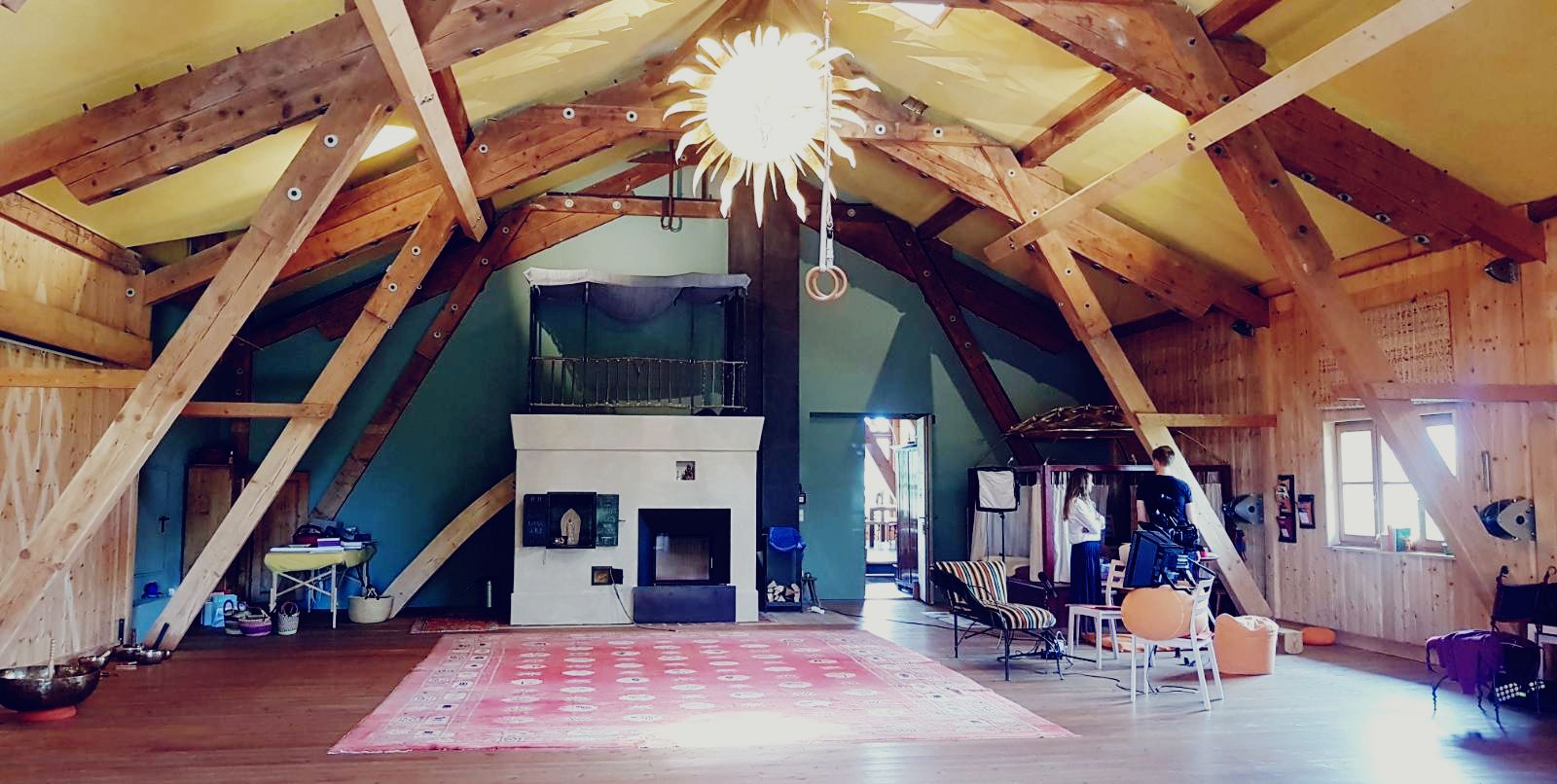
The programme was filmed at the Haus der Achtsamkeit in Osterloh, Bavaria, a space dedicated to the practice of mindfulness created by Maria T. Kluge, who kindly hosted the team during filming. Joanne King brought the written materials to life in front of the camera and through the audio recordings. The videos were filmed by Sven Jansel and edited by him and his team at Edgelight in Salzburg, Austria. The audio recordings were professionally recorded at Brighton Voice Studio and edited by Thorsten Barnhofer.
The materials were initially published on Thinkific solely to support research studies. Caring Mindfulness became publicly accessible after the programme and the research in which it was being used featured in a BBC documentary about neuroplasticity produced by Melissa Hogenboom and her team. The webpage accompanying the documentary included a link to the intervention, unexpectedly making Caring Mindfulness publicly available.
Since then, without any further promotion, people from around the world have continued to find and use it. There are now more than 42,000 subscribers. Caring Mindfulness remains freely accessible on this platform for people who would like to work with it. Please be aware, however, that our limited resources mean that we are unable to provide individual support or respond to queries about the course.
Generosity and dāna
Caring Mindfulness is offered freely. If you find the programme helpful and its ideas and values resonate with you, you may wish to make a voluntary contribution in the spirit of dāna, a term used in Buddhist traditions for the practice of generosity.
At the end of each session, you will find an opportunity to make a contribution. A small amount is suggested as a guide, but giving is entirely optional: you are equally welcome to give any amount or nothing at all.
We hope you enjoy Caring Mindfulness and that your engagement with the programme is of benefit both to you and to those around you.
Course curriculum
-
1
Caring Mindfulness - Cultivating the Skills to Care for Ourselves in Challenging Times
-
Caring Mindfulness - Cultivating the Skills to Care for Ourselves in Challenging Times
-
-
2
Introduction
-
Welcome to this Course
-
How to Use this Course
-
The Shape of the Course
-
Who is this Course for? - A Note of Caution and Care
-
Contemplation - As You Begin this Journey of Discovery
-
Inspiration: "Begin it Now"
-
-
3
Background Information: Why Stress Tends to Spiral and How Mindfulness Can Help
-
Understanding Stress and How It Can Lead Into Anxiety and Depression
-
Our Attempts at Dealing with Anxiety and Depression Can Inadvertently Keep Them Going
-
Why Ruminating and Worrying Makes Us Increasingly Vulnerable
-
What Can We Do?
-
Learning Other Ways of Responding
-
A Small, But Profound Shift
-
Why We Need to Practice
-
A Particular Kind of Learning
-
Inspiration: "Morning"
-
-
4
Getting the Most Out of this Course
-
Getting the Most Out of This Course
-
Preparing to Start
-
Journaling
-
The Structure of the Programme
-
-
5
Session 1: Bringing Awareness to Life
-
Bringing Awareness to Life
-
Mindfulness Begins with Paying Attention on Purpose
-
Opening the Senses
-
Bringing Awareness to the Body
-
Bringing Awareness to Daily Life
-
Session 1 Home Practice
-
Body Scan Meditation (Audio)
-
Journaling
-
Supporting Caring Mindfulness
-
-
6
Session 2: Becoming Aware of the Wandering Mind
-
Becoming Aware of the Wandering Mind
-
We Can Easily Get Lost in Thought
-
Getting in Touch with the Breath
-
If You Find Yourself Feeling Frustrated...
-
Inspiration: "Simplicity"
-
Session 2 Home Practice
-
Body Scan Meditation (Audio)
-
Body and Breath Meditation (Audio)
-
Journaling
-
Supporting Caring Mindfulness
-
-
7
Session 3: Coming Home to Presence
-
Coming Home to Presence
-
Using the Breath and the Body as an Anchor to the Presence
-
Body Sensations Can Provide a Tangible Focus for Our Attention
-
The Mind Shapes the Body - The Body Shapes the Mind
-
Embodying a Mindful Stance: Sitting and Standing Postures for Meditation
-
Shifting Perspective in Daily Life: The Mindful Pause
-
Inspiration: "Ten Thousand Flowers in Spring"
-
Session 3 Home Practice
-
Stretch And Breath (Audio)
-
Breath And Body Meditation (Audio)
-
Journaling
-
Supporting Caring Mindfulness
-
-
8
Session 4: Moving Closer - Being Aware of Subtle Feeling States
-
Moving Closer - Being Aware of Subtle Feeling States
-
Breaking the Chain of Events
-
Noting and Exploring Subtle Feeling States
-
Holding Experience in a Wide and Spacious Awareness
-
Recognising the Voice of Distress
-
Inspiration: "Stand Firm in That Which You Are"
-
Session 4 Home Practice
-
Sitting Meditation (Breath, Body, Sounds, Thoughts, Choiceless Awareness) (Audio)
-
Mental Noting (Audio)
-
Journaling
-
Supporting Caring Mindfulness
-
-
9
Session 5: Bringing Acceptance to What is Difficult
-
Bringing Acceptance to What is Difficult
-
Practicing Acceptance
-
Why It Is Helpful to Turn Toward the Difficult
-
What Is Important to Keep in Mind When Engaging in This Practice
-
Session 5 Home Practice
-
Sitting with the Difficult Meditation (Audio)
-
Journaling
-
Supporting Caring Mindfulness
-
-
10
Session 6: Finding a Different Relation to Thoughts
-
Finding a Different Relation to Thoughts
-
Our Thoughts are Not Necessarily Reflections of the Truth
-
Observing and Exploring Difficult Thoughts
-
Inspiration: "Search Your Heart"
-
Other Ways of Establishing a Balanced Perspective of Our Thoughts
-
Session 6 Home Practice
-
Observing Difficult Thoughts Meditation (Audio)
-
Journaling
-
Supporting Caring Mindfulness
-
-
11
Session 7: Cultivating Compassion for Ourselves and Others
-
Cultivating Compassion for Ourselves and Others
-
Holding Our Suffering with Kindness
-
Awakening Our Capacity for Compassion
-
Bringing Compassion to Ourselves
-
Inspiration: "Love after Love"
-
Kindness for Ourselves and Others
-
Session 7 Home Practice
-
Meditation on Self-Compassion (Audio)
-
Journaling
-
Supporting Caring Mindfulness
-
-
12
Session 8: Taking Care of Ourselves
-
Taking Care of Ourselves
-
Living in Line with Your Values
-
Inspiration: "From Out the Cave"
-
Simply Being with What Arises
-
Session 8 Home Practice
-
Choiceless Awareness Meditation (Audio)
-
Journaling
-
Supporting Caring Mindfulness
-
-
13
Session 9: Engaging in Life Mindfully
-
Engaging in Life Mindfully
-
Where Have We Come From, Where Are We Now
-
Supporting Caring Mindfulness
-
Where to Go from Here
-
"Come, whoever you are"
-